π₀.₅
Paper · LIBERO · S=10
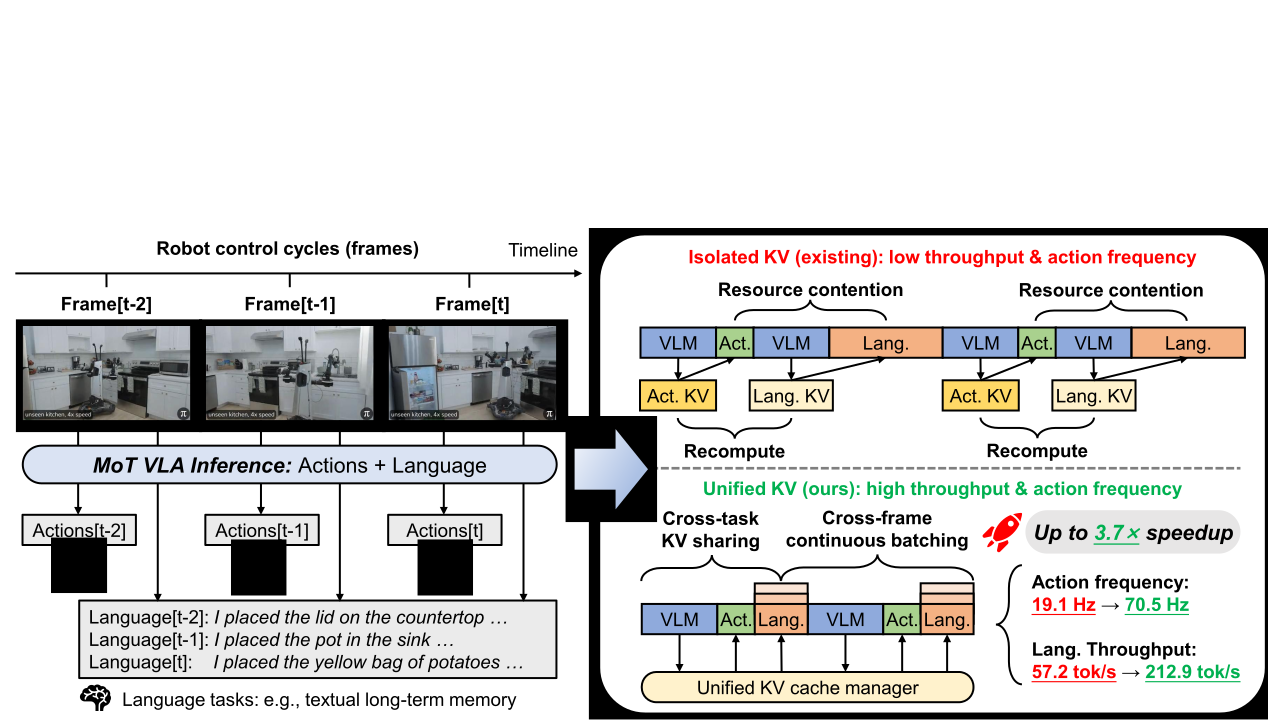
TL;DR OxyGen treats the KV cache as a shared resource across experts and control frames, enabling action and language generation to run together without redundant context encoding or blocked control.
LIBERO demo
Measured model inference and 1× simulator timing. OxyGen advances unfinished text requests across frames while the isolated openpi baseline blocks on each request.
Put the white mug on the plate and the chocolate pudding to the right of the plate
OxyGen vs. isolated openpi baselineπ0.5 · RTX 4090 & Jetson AGX Thor
Challenge and method
Isolated action and language paths repeat the VLM prefix and compete for the same device. OxyGen shares the prefix across experts and batches unfinished language requests across control frames.
Paper evaluation
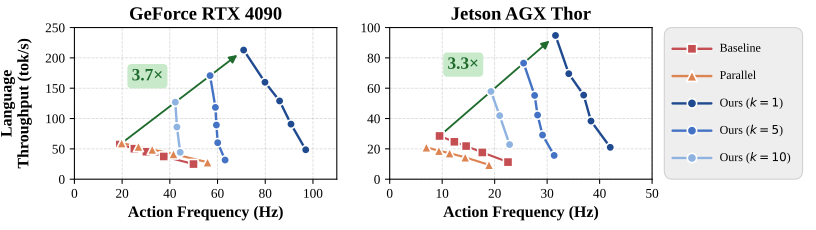
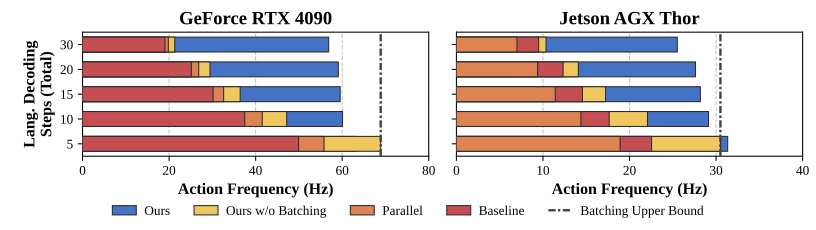
Evaluated with π0.5 on RTX 4090 and Jetson AGX Thor across LIBERO, DROID, and ALOHA workloads, including an on-board humanoid deployment.
Extended validation
The π0.5 curve is from the paper evaluation; Xiaomi-Robotics-0 and StarVLA are later validations using their native implementations on the same RTX 4090. Here, N is the language decoding length and k the decoding steps per request in each frame.
Paper · LIBERO · S=10
4.7B · native implementation · S=5
5.07B · native implementation · S=4
StarVLA · shared Qwen3-VL-4B prefix
StarVLA Qwen3.5 backbones
StarVLA’s heterogeneous heads were trained separately; these measurements validate system scaling and shared-prefix fan-out, not the quality of a jointly trained multi-expert policy.
LIBERO textual memory
We adapt π0.5 with suffix-only LoRA to describe completed task progress from the current observation. The action path keeps the base model and shared prefix unchanged.
Videos load only when played.
Place both objects in the basket.
Place both moka pots on the stove.
Open resources
Code, checkpoints, annotations, and the paper are available as separate entry points so each part can be reused independently.
Citation
@article{li2026oxygen,
  title={OxyGen: Unified KV Cache Management for VLA Inference under Multi-Task Parallelism},
  author={Li, Xiangyu and Tang, Huaizhi and Ding, Xin and Wang, Weijun and Cao, Ting and Liu, Yunxin},
  journal={arXiv preprint arXiv:2603.14371},
  year={2026}
}